
Road Trip: Professor’s book on bus travel reveals portrait of America

Author Kath Weston, an Anthropology PhD from Stanford University, grew up in a working-class family and attended college with the help of financial aid, took her first bus trip alone when she was 16, and that unforgettable trip showed her that traveling on the bus was much more than just a way to get somewhere.

Before joining the University of Virginia faculty this fall, she spent more than five years crisscrossing the nation on buses, chronicling the lives of Americans who travel via the least expensive mass transportation option. She refers to her new book, Traveling Light: On the Road with America’s Poor, as a journey full of unexpected richness. Her new book describes her fellow passengers’ colorful humanity and tackles issues of class, race and dubious access to America’s opportunities.

For more information about the show or to see the full text, visit the Oscar Show’s blog

Jefferson Society speaker addresses “Why Should You Bother to Vote?”

Professor Loren E. Lomasky of the University of Virginia’s Program in Political Philosophy, Policy, and Law addressed the Jefferson Literary and Debating Society on October 17, 2008, on the question: “Why Should You Bother to Vote?”
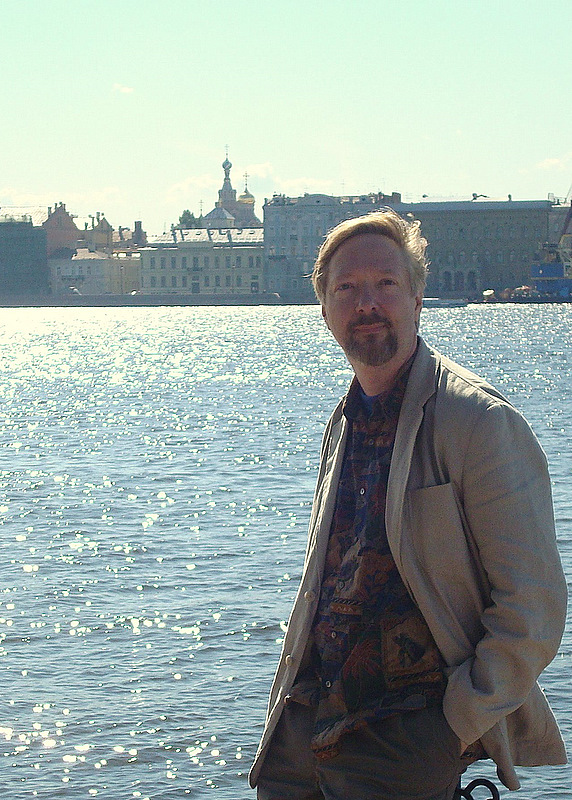
Professor Lomasky addressed many of the reasons put forward for voting, and found that they fell into three main lines of argument: Utilitarian considerations, the generalization argument, and the expressive argument. In the course of his presentation, Professor Lomasky came to some surprising conclusions about our civic duty to vote. A lively discussion followed.

Loren Lomasky is Cory Professor of Political Philosophy, Policy and Law, and Director of the Political Philosophy, Policy and Law Program. Professor Lomasky is best known for his work in moral and political philosophy. Lomasky has been the recipient of many awards including the 1991 Matchette Prize for his book Persons, Rights, and the Moral Community.

Eyeing the Biological Clock

In today’s show, adapted from an article written by Fariss Samarrai, Senior News Officer for the Office of Public Affairs, we will look at a team of UVa researchers who have discovered a switching mechanism in the eye that plays a key role in regulating the sleep/wake cycles in mammals.

Biologists at the University of Virginia have discovered a switching mechanism in the eye that plays a key role in regulating the sleep/wake cycles in mammals. The new finding demonstrates that light receptor cells in the eye are central to setting the rhythms of the brain’s primary timekeeper, the suprachiasmatic nuclei, which regulates activity and rest cycles. The finding appears in the current issue of the Proceedings of the National Academy of Sciences.

Susan Doyle, a research scientist at U.Va. and the study’s lead investigator said, “The finding is significant because it changes our understanding of how light input from the eye can affect activity and sleep patterns.”

For more information about the show or to see the full text, visit the Oscar Show’s blog

GenTech Season 3, Episode 3: New ITRT Guidelines

Over the Summer, the Commonwealth of Virginia released new guidelines for Instructional Technology Resource Teachers. The new document updates the 2005 version, “revisits the original intent of the ITRT program; examines results, as documented through three studies; and offers recommendations.”

In this show, Steve talks with two ITRTs who are old friends of the show: Tina Coffey from Salem City Schools, and Sean Sharp, from Floyd County Schools. They share their reactions to the new guidelines and provide insight into the changing and difficult-to-capture nature of their positions.


Dr. Strangelove in the Caucasus; Or, How Saak Goes his War Game On

Nicolai PetroNicolai N. Petro is professor of political science at the University of Rhode Island. He is a graduate of the University of Virginia, where he was an Echols Scholar and member of the Jefferson Society. In addition to authoring eight books on Russian politics, he has served as special assistant for policy in the US State Department, and as advisor to the mayor of the Russian city of Novgorod the Great. In addition to commenting in the International Herald Tribune, Boston Globe, Christian Science Monitor, and Asia Times, he writes an occasional blog devoted to Russia at OpEdNews.com.

On September 26, 2008, Petro addressed the Jefferson Society on the topic: Dr. Strangelove in the Caucasus; Or, How Saak Goes his War Game On. Visit Mr. Petro’s website for a detailed timeline of the recent crisis in the Caucasus.

Large Hadron Collider Begins Operation in Geneva

In today’s show, adapted from an article written by Fariss Samarrai, Senior News Officer for the Office of Public Affairs, we will discuss the work of Brad Cox, professor of physics and a principal investigator with the University of Virginia’s High Energy Physics Group and his teams involvement with the new Large Hadron Collider near Geneva Switzerland.

In a recent show we discussed UVa researcher team’s attempt to verify or refute the existence of the Higgs Boson. On September 10, 2008, an international team of scientists circulated the first beam of protons at nearly the speed of light around the 17-mile Large Hadron Collider on the Franco-Swiss border near Geneva. The $3.2 billion LHC, under construction for 15 years, is now the world’s most powerful particle accelerator.

For more information about the show or to see the full text, visit the Oscar Show’s blog


GenTech: Jeff Nugent of the Center for Teaching Excellence at VCU

Jeff NugentOur guest for this show is Jeff Nugent, Associate Director at the Center for Teaching Excellence (CTE) at Virginia Commonwealth University (VCU) . The VCE, founded in 2001, is charged with supporting 3,000 faculty members at VCU and now plays a key role in VCU’s VCU 2020: Vision for Excellence strategic plan.

In this show, Jeff and the boys talk about the CTE and its programs, consider ways to build and sustain community around technology projects and programs, and weigh in on heady matters such as the adoption curve and cognitive issues surrounding the learning of new tools.

A few links from the conversation:


Reflections on Race and Gender in Politics Forum

In today’s show, we share comments and reflections from the UVa Faculty Roundtable concerning Race and Gender in Politics.

Last Thursday, the Miller Center of Public Affairs hosted the UVa Faculty Round Table on Race and Gender in Politics. Sponsored by the University of Virginia’s Arts & Sciences Magazine, the forum was moderated by Douglas Blackmon, the Atlanta bureau chief for the Wall Street Journal. The panel included UVa faculty members, Paul Freedman, Brian Nosek, Lynn Sanders, Vesla Weaver and Nick Winter.

Moderator, Douglas Blackmon called this point in time “an extraordinary moment in American history and American discourse,” while Associate Politics Professor Paul Freedman referred to this time as “Christmas” for political scientists because of the multicultural base of the presidential candidates.

For more information about the show or to see the full text, visit the Oscar Show’s blog


Forbes and Strawn address Jefferson Society on technology and society

Nancy Forbes, author of Imitation of Life: How Biology is Inspiring Computing, and George O. Strawn, CIO of the National Science Foundation, spoke to the members of the Jefferson Society on the topic of “The Development and Dangers of Technology in Society.” Their presentation took place on September 19. 2008. A question-and-answer period followed.

TIMELINE FOR PODCAST:

0:00 — Nancy Forbes: The Future of Information Technology

0:08 — Evolutionary algorithms

0:12 — Neural networks

0:14 — DNA computing

0:16 — Computer immune systems

0:24 — George O. Strawn: The Future and Information Technology

0:35 — IT over time

0:42 — New IT applications

0:51 — “Education’s End”

0:55 — Q: How will computer algorithms be able to counter human-created viruses?

0:57 — Q: Under what circumstances should change be considered a threat to society?

1:00 — Q: Will computers develop “autoimmune” disorders?

1:04 — Q: How do you account for the disconnect between machines’ abilities and our inability to take advantage of them?

1:08 — Q: Should we be concerned about giving computers human qualities?

1:10 — Q: What aspects of technological progress worry you?

Kevin Lynch on the $70 million estimate for new Ragged Mountain Dam

Kevin LynchFormer City Councilor Kevin Lynch joins Coy Barefoot on the September 23rd edition of WINA’s “Charlottesville-Right Now!” to talk about his opposition to the currently adopted 50 Year Community Water Supply Plan. Lynch is also a member of Citizens for a Sustainable Water Plan. The Rivanna Water and Sewer Authority announced this week that the cost estimate for the new Ragged Mountain Dam has been increased to nearly $70 million

Race and Gender in Politics

In today’s show, we introduce the Moderator and UVa Faculty panel participating in the Race and Gender in Politics Forum being held tomorrow evening at 7:00 PM at the Miller Center of Public Affairs, located at 2201 Old Ivy Road, in Charlottesville, VA. This event is free to the public.

With the election season upon us, and the diverse nature of the major candidates, Americans are faced with unique challenges when they go to the polls this November 4th. With the notable exception of Geraldine Ferraro in 1984, the major candidates for the office of President of the United States have been white males. But this election season, both major political parties have offered candidates that begin to explore the multicultural basis of our nation.

For more information about the show or to see the full text, visit the Oscar Show’s blog
Tomorrow evening, September 25th at 7:00PM, the Miller Center of Public Affairs will be hosting the UVa Faculty Round Table on Race and Gender in Politics. This event is sponsored by the University of Virginia’s Arts & Sciences Magazine will be Moderated by Douglas A Blackmon, the Atlanta bureau chief for the Wall Street Journal. This forum will discuss many of the issues that face the electorate this season. The panel will include UVa faculty members, Paul Freedman, Brian Nosek, Lynn Sanders, Vesla Weaver and Nick Winter.